Roofing Decisions · Herndon, VA
Roof Repair or Replacement in Herndon? A Practical Decision Guide
A leak does not automatically mean the entire roof needs replacement, and a small visible defect does not always mean a spot repair is the best long-term choice. The decision begins with the source, surrounding condition, and roof-wide context.
Published September 2, 2026 · Northern Virginia
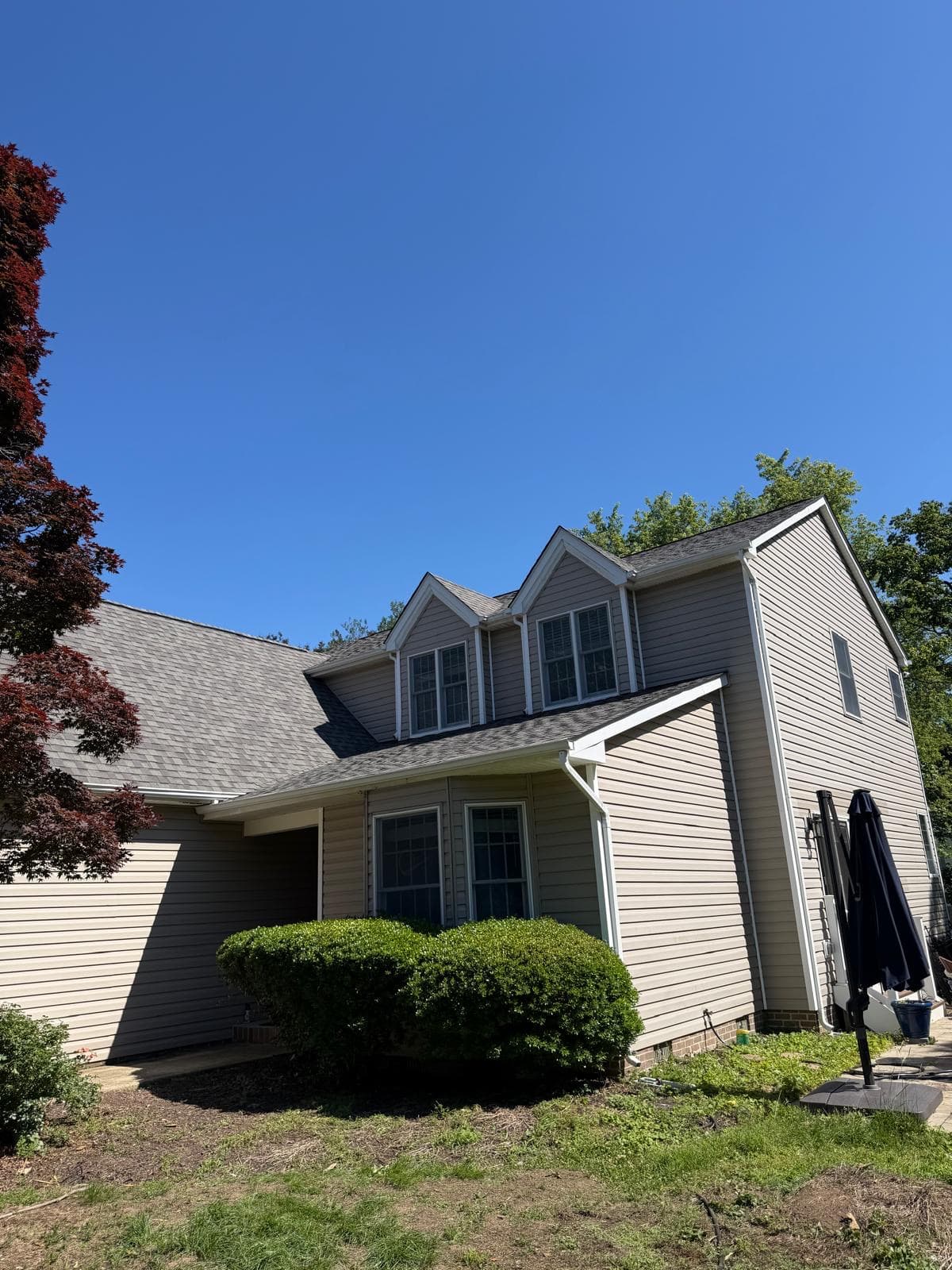
Begin With the Leak Source, Not the Ceiling Stain
Water can travel along framing, decking, insulation, or other materials before it becomes visible indoors. The stain may be below the entry point, so a useful inspection considers the exterior roof area, penetrations, flashing, valleys, walls, and relevant attic conditions instead of treating the interior mark as an exact map.
Record when the leak appears. Wind-driven rain, prolonged rain, melting snow, or a plumbing or condensation issue can produce different patterns. Clear observations help narrow the investigation and prevent a repair aimed at the wrong source.
- Photograph interior staining and note whether it changes after specific weather.
- Identify nearby roof penetrations, walls, valleys, or transitions.
- Look for displaced materials or visible damage from a safe location; do not walk a wet or damaged roof.
- Protect the interior from ongoing water while the cause is evaluated.
When a Focused Roof Repair May Make Sense
Repair may be appropriate when the problem is isolated, surrounding roofing remains serviceable, compatible materials are available, and the defect can be corrected without creating a patchwork of uncertain transitions. Examples can include a specific flashing issue, a limited damaged area, or a localized penetration problem, but the actual recommendation depends on inspection findings.
The repair scope should identify the targeted area, the materials being removed or replaced, and how the repaired section will connect to existing roofing. It should also be clear about what the repair is intended to address and which roof areas are outside the scope.
- Ask whether damage appears isolated or part of a broader pattern.
- Confirm that surrounding materials can support a durable repair.
- Review how replacement materials will integrate with existing roofing.
- Keep the repair scope and exclusions in writing.
When Replacement Deserves Consideration
Replacement may be more practical when defects are widespread, multiple repairs have accumulated, materials are broadly deteriorated, or the roof has several active problem areas. A roof-wide project also allows underlayment, flashing details, penetrations, ventilation components, and visible deck conditions to be reviewed as one coordinated system.
Replacement should not be recommended from age alone without considering condition, and repair should not be chosen only because its initial scope is smaller. The decision should compare the likely result, the condition of the remaining roof, and how much uncertainty stays in place after the proposed work.
- Review the roof as a complete system, not only the visible leak area.
- Identify previous repairs and whether they addressed recurring symptoms.
- Discuss how penetrations, flashing, and ventilation components are included.
- Understand how concealed deck conditions will be documented if found.
Flashing and Transitions Often Decide the Outcome
Roofing materials meet walls, chimneys, valleys, skylights, vents, pipes, and edges. These transitions concentrate water and depend on detailed installation. A proposal that names only the field shingle while leaving flashing and penetrations vague does not explain the full work.
Ask the contractor to describe the areas being inspected and how key transitions are handled in the proposed scope. The answer should be specific to the observed roof configuration rather than a generic statement that everything will be sealed.
- Review wall intersections, valleys, vents, pipes, and edge conditions.
- Clarify which flashing is replaced, reused, or outside the scope.
- Confirm how accessories and penetrations coordinate with the roofing system.
- Avoid relying on surface sealant as a substitute for a defined assembly.
Ventilation and Attic Conditions Provide Context
Attic heat, moisture, insulation, and airflow can affect roof performance and may create symptoms that resemble an exterior leak. An inspection may consider visible attic conditions when they are safely accessible and relevant to the concern. These observations help separate water entry from condensation or other interior sources.
Ventilation changes should be based on the roof and attic configuration, not added automatically. If work is proposed, the written scope should identify the intended components and how they fit the existing system.
- Note condensation, staining, or damp insulation where visible.
- Keep exhaust ducts and roof penetrations in the investigation.
- Ask why a ventilation change is recommended and what condition it addresses.
- Coordinate any proposed change with the complete roof system.
Compare Repair and Replacement Scopes Clearly
A repair estimate and replacement estimate are not competing versions of the same job. Each should state the area covered, preparation, materials, flashing, penetrations, disposal, protection, cleanup, and assumptions. For replacement, the scope should also explain how visible deck damage or other concealed conditions will be handled if discovered after removal.
Roofing Roughnecks is Kenney Construction's roofing division. For a Herndon homeowner, the goal of the initial review is to define the likely source, explain the observed condition, and provide a written scope that makes the repair-versus-replacement tradeoff understandable.
- Ask for photos or a clear explanation of observed conditions.
- Verify that proposals address the same roof areas and details.
- Separate included work from optional or excluded work.
- Do not authorize storm-related work based solely on unsolicited urgency.
What to Do After a Storm or New Leak
Document the condition, limit interior damage where it is safe to do so, and arrange a qualified inspection. Avoid climbing onto the roof or making temporary changes that create additional hazards. Keep photographs, dates, and written communications organized.
A measured evaluation is more useful than an immediate assumption that the roof must be replaced. The appropriate scope follows from the actual defect, the condition of the remaining system, and the homeowner's longer-term plans.
Frequently Asked Questions
Does one roof leak mean the whole roof needs replacement?
No. A leak can result from an isolated defect, but it can also be one symptom of wider deterioration. Inspection of the source and surrounding roof condition is needed before choosing the scope.
Can an older roof still be repaired?
Possibly. Repair suitability depends on the specific defect, surrounding material condition, compatibility, prior repairs, and whether the proposed work can create a durable transition.
Should a roofing proposal describe flashing work?
Yes. Flashing, penetrations, valleys, walls, and other transitions are important parts of the roof system and should be addressed when they are included in the scope.
Does Roofing Roughnecks serve Herndon?
Yes. Roofing Roughnecks provides roof repair and replacement services in Herndon and across Northern Virginia as Kenney Construction's roofing division.
Related Planning Resources
Get a Clear Roofing Scope
Request an inspection and written explanation of the condition, recommended work, and the difference between a targeted repair and roof-wide replacement.
Request a Roofing Estimate